
By Lux Automaton Editorial • July 23, 2026 • 6 min read
📥 FREE DOWNLOAD & ACTIVITY PACKAGE
Download the complete Dr. Dooley Smart Health Adventure package, including the printable activity sheet, lesson plans, story guide, and publishing kit.
Welcome to Dr. Dooley’s Smart Health Lab
“Alright fam,” Dr. Torrey Dooley says as the doors to the LUX Smart Health Lab slide open. “Today, we are not looking for a robot doctor. We are looking for something better: smart tools that help real people give safer, kinder, clearer care.”
Ace adjusts his glasses. LANA opens the team’s digital mission map. Three glowing destinations appear:
- A smart pharmacy filled with organized medicine stations,
- A cheerful wellness robot that supports healthy routines, and
- A holographic data garden where health patterns grow like digital plants.
Dr. Dooley gives the team one challenge: Find three ways AI can help—and three moments when people must lead.
That challenge turns the clips into one continuous adventure. Every stop adds a new Health Hero skill: verify, care, and protect.
“AI is your assistant, not your replacement. The tool can support the work. People bring the judgment, trust, and care.” — Dr. Torrey Dooley, The Hood Nurse
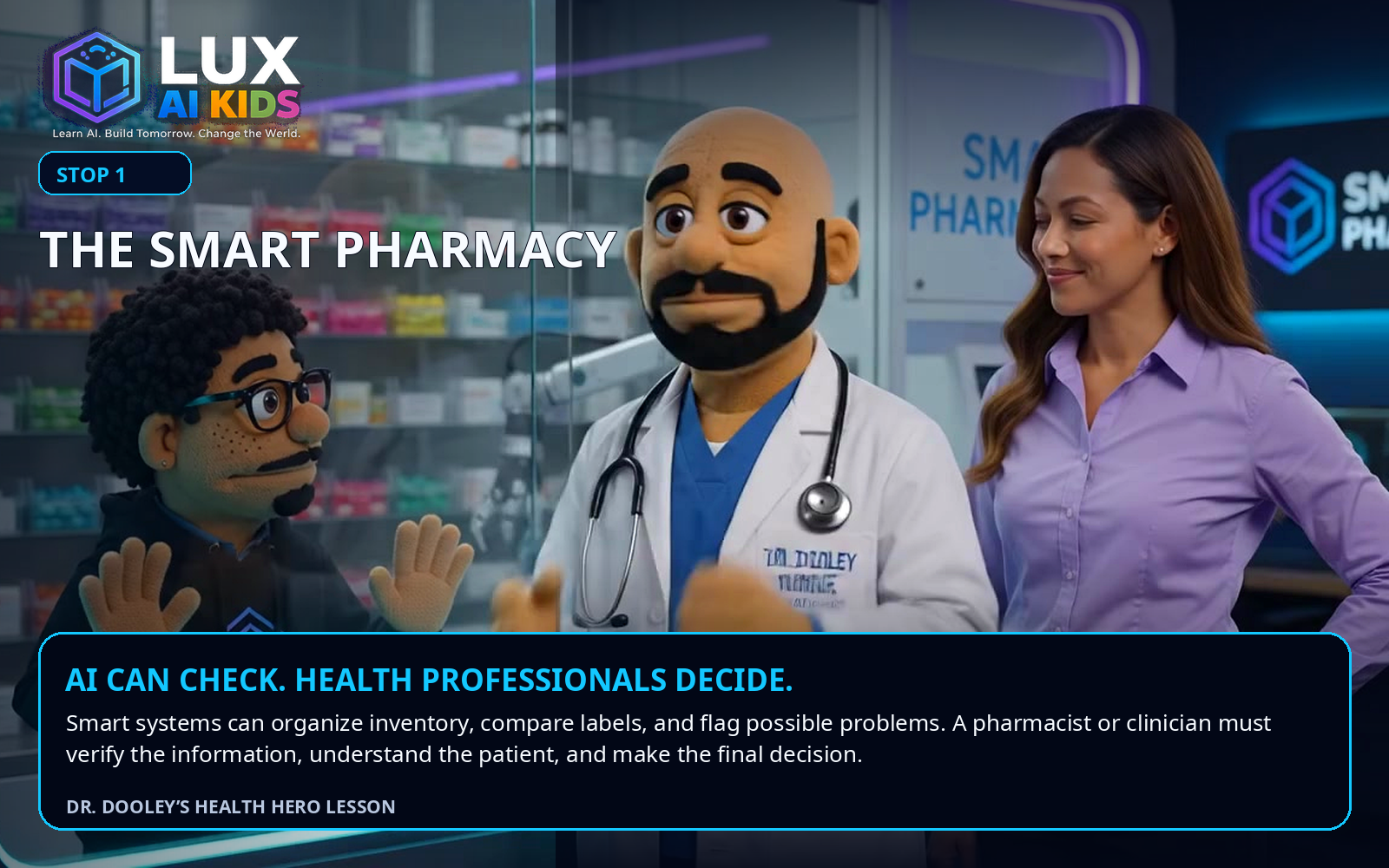
Stop 1: The smart pharmacy — verify before you trust
The first stop looks like a pharmacy from the future. Clear shelves hold carefully organized packages. A robotic arm moves items between stations. Screens compare labels, inventory, and instructions.
Ace watches the system scan a container and asks the question many children—and adults—might ask: “If the computer is this smart, does it choose the medicine?”
Dr. Dooley keeps it real: No.
A smart pharmacy system could help a trained professional by organizing inventory, checking whether labels match an order, flagging information that deserves another look, and helping a pharmacist find records more efficiently.
But a flag is not a diagnosis, and a match is not a medical decision. A pharmacist or other qualified healthcare professional still needs to understand the patient, review the information, consider allergies and other medicines, communicate clearly, and decide what action is appropriate.
LANA calls this the verify loop:
1. The system finds or compares information.
2. A person checks the source and the context.
3. A qualified professional makes the decision.
4. The patient or caregiver receives a clear explanation.
This is also a practical safety lesson for children: Never take, share, stop, or change medicine because an AI tool suggested it. Medicine questions belong with a trusted adult and a qualified pharmacist, nurse, or doctor.
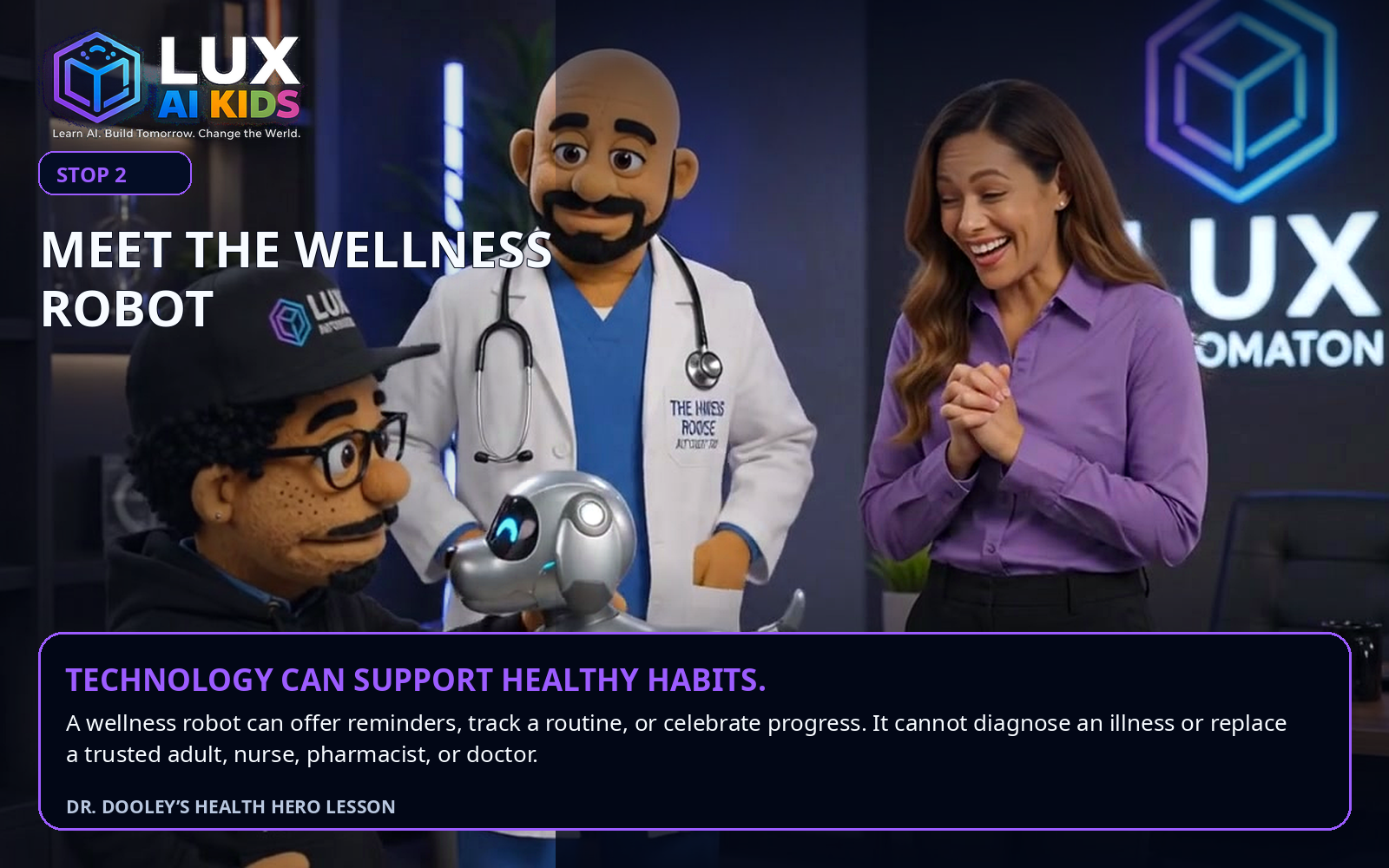
Stop 2: Meet the wellness robot — support is not diagnosis
At the second stop, a small silver wellness robot rolls into the room. Its bright eyes light up when Ace waves. It can celebrate a completed movement break, remind someone to drink water, guide a short breathing exercise, or help a family keep track of a healthy routine.
Ace immediately wants to know whether the robot can tell when someone is sick.
Dr. Dooley explains the boundary: a wellness tool may collect answers or notice changes, but it should not pretend to understand a person the way a healthcare professional does. A number on a screen cannot replace a conversation, a physical examination, clinical training, or the ability to notice what a person is not saying.
A well-designed wellness robot can be useful when it gives age-appropriate reminders, makes routines easier to follow, celebrates progress without shame, and encourages a child to involve a trusted adult when something feels wrong.
“Health is wealth—but healthy support should feel respectful, realistic, and human.” — Dr. Dooley
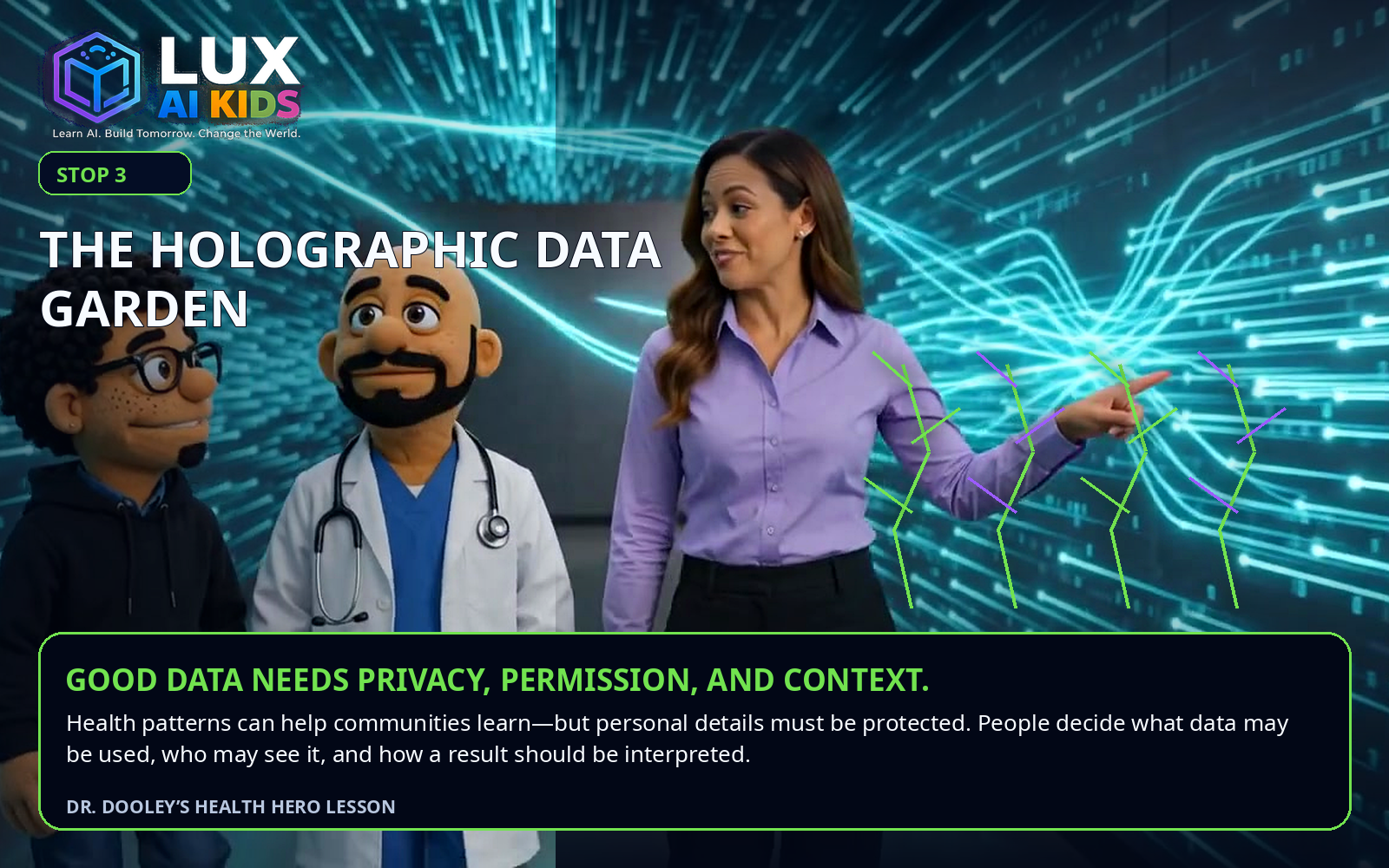
Stop 3: The holographic data garden — protect what helps people grow
The final doors open into a tunnel of glowing lines. The lines branch, connect, and bloom into a holographic garden. Each digital plant represents a pattern: sleep routines, activity, air quality, appointment access, or another type of health information.
LANA explains that groups can learn useful things from data. A community might discover that families need a clinic open later in the evening. A school might notice that students need more opportunities for movement. Researchers might see a pattern that deserves careful study.
Before data enters the garden, the team asks: Do we have permission? Do we actually need it? Can identifying details be removed? Who will be allowed to see it? How long will it be kept?
Dr. Dooley points to one plant with missing branches. “Check this out. If the data leaves some communities out, the picture can look complete even when it is not.”
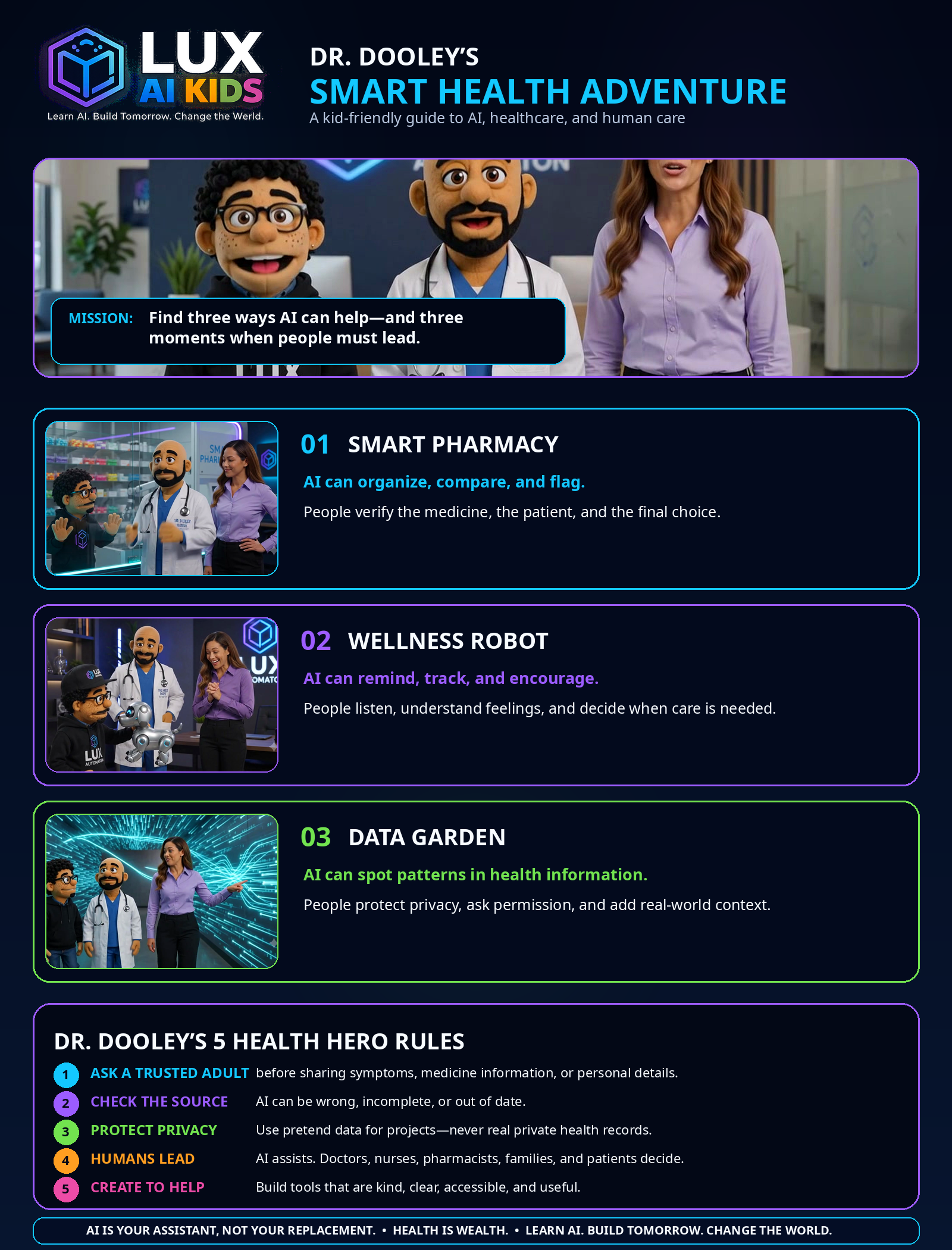
Dr. Dooley’s five Health Hero rules
1. Ask a trusted adult before sharing symptoms, medicine information, or personal details.
2. Check the source. AI can be wrong, incomplete, or out of date.
3. Protect privacy. Use pretend data for projects—never real private health records.
4. Keep humans in charge. AI assists; qualified people make health decisions.
5. Create to help. Build tools that are kind, clear, accessible, and useful.
The three-question health technology test
1. What is the tool helping with? Name the specific task clearly.
2. What must a person still check or decide? Identify the human responsibility.
3. What information should stay private? Protect names, addresses, and medical records.
---
⚠️ Important health and safety note
This story and its activities are for general education only. They do not provide medical advice, diagnosis, or treatment. Never use an AI tool as a substitute for a qualified healthcare professional. For symptoms, medicines, diagnoses, or treatment decisions, speak with an appropriate licensed clinician or pharmacist. In an emergency, contact local emergency services.