
Keep learning with the companion guide.
Open this simple resource in a new tab, then use it at your own pace.
Open the free guide →A strong newsletter does not need to be loud. It needs to be dependable. LANA Weekly can become the place where Lux Automaton explains what changed, what customers can learn, what Asa is building, and what the community should try next.
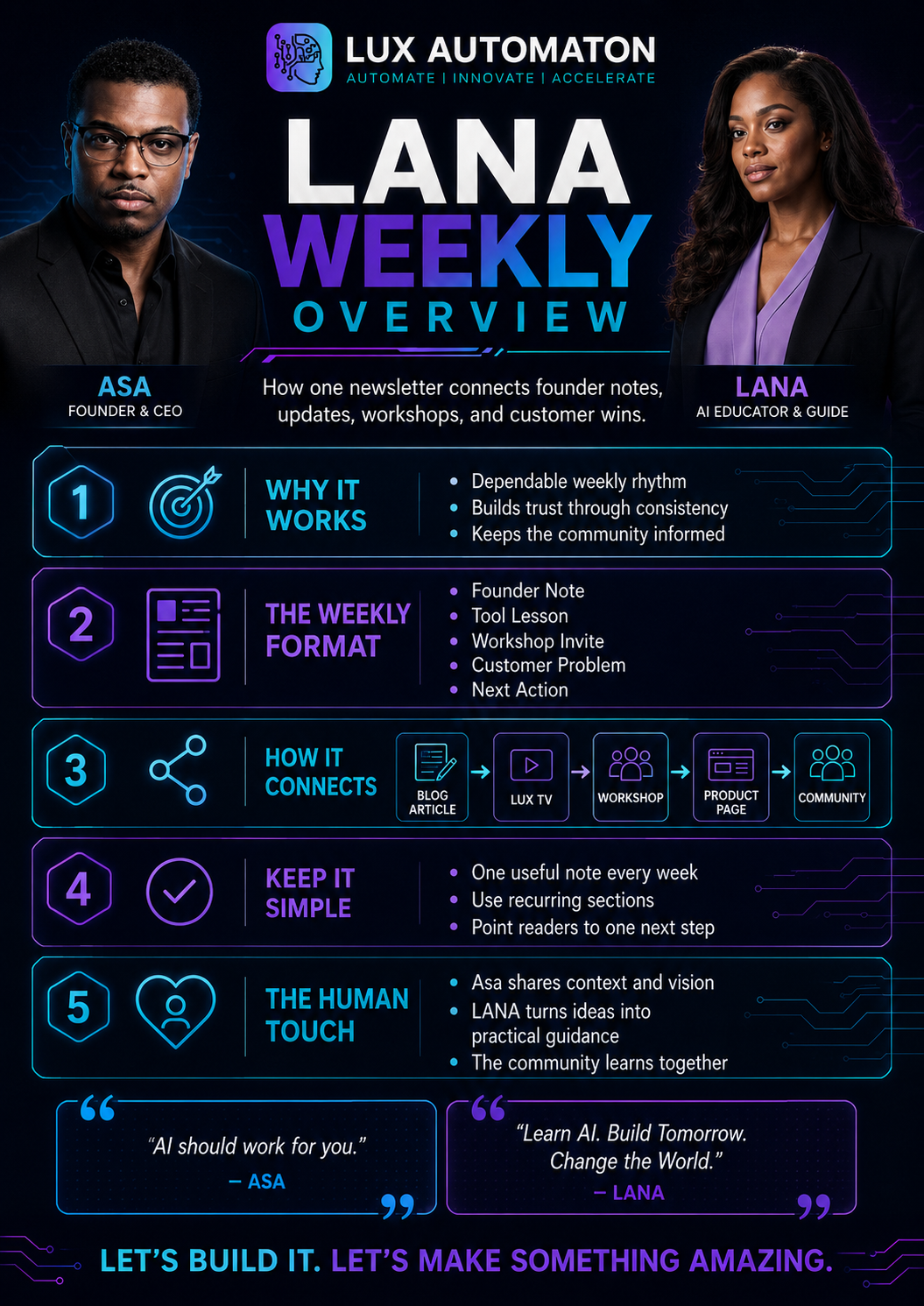
The format should be simple: one founder note, one tool lesson, one workshop invite, one customer problem, and one next action. That rhythm makes the newsletter useful even before the audience knows every product name.
For Lux Automaton, the newsletter is also a bridge. A reader can move from a blog article to Lux TV, from Lux TV to a workshop, and from the workshop to a product page that solves the exact problem they just learned about.
That bridge works because every issue has a job. It should help a reader understand one idea, see why it matters, and choose one useful next move. Over time, that dependable rhythm becomes part of how a community learns together.
01 — Publish one useful note every week
Dependability is an editorial decision. It begins with a promise that is small enough to keep: once a week, publish one note that helps a reader understand something, try something, or make a better decision.
A useful note does not need to summarize everything happening inside Lux Automaton. It can explain one product change in plain language, teach one practical automation lesson, share one founder decision, or unpack one customer problem. The test is simple: by the end of the issue, can the reader say what changed, why it matters, and what to do next?
The weekly schedule should also be light enough to survive busy weeks. A practical production rhythm looks like this:
1. Collect the signals. Pull ideas from product work, customer questions, workshops, support conversations, and community discussions.
2. Choose one central idea. Do not make five unrelated announcements compete for attention.
3. Draft in everyday language. Explain the idea as if you were helping one smart, busy person who does not live inside the product.
4. Review the facts and links. Confirm product claims, dates, workshop details, permissions, and customer-story consent.
5. Publish, listen, and save the response. Replies and questions become material for the next issue.
A fixed cutoff matters. When a product update is not ready, it rolls to the next issue. When a customer story still needs approval, it waits. The rhythm remains dependable because the team protects trust instead of filling space.
Asa’s founder voice gives the note context: what the team is learning, why a decision was made, and what the community should watch next. The goal is not to sound perfect. It is to be clear, honest, and useful.
“The newsletter should not feel like another campaign. It should feel like a dependable conversation.” — Asa Pritchard

02 — Use recurring sections
Recurring sections lower the cost of attention for both the team and the reader. The team does not begin with a blank page every week, and the reader quickly learns where to find the part that matters most.
The structure should be familiar without becoming mechanical. Each section has a different purpose:
- Founder Note: The why behind the week: context, a decision, a lesson, or a question Asa is thinking through.
- Product Update: What changed, who it helps, what is still in progress, and where the reader can learn more.
- Tool Lesson: One practical technique the reader can apply immediately, explained without jargon.
- Workshop Invite: A clear opportunity to practice the idea with other learners instead of only reading about it.
- Customer Problem or Win: A real challenge, lesson, or outcome that keeps the newsletter grounded in lived experience and permission-based storytelling.
- Next Action: One primary step: watch, register, reply, try the workflow, visit the product page, or join the discussion.
Not every issue needs a long version of every section. A founder note might be 120 words. A tool lesson might be three steps. A product update may appear only when there is something meaningful to explain. The value comes from the pattern, not the word count.
LANA’s role is to keep the pattern practical. She translates “what the team built” into “what this helps you do,” names the limits of the tool, and gives the reader a safe next experiment. Familiar structure makes room for better teaching because the audience is not spending energy decoding the format.
A familiar format does not make the newsletter repetitive. It makes the useful parts easier to recognize.

03 — Connect readers to workshops and products
Publishing the email is only half the job. LANA Weekly becomes community infrastructure when it intentionally connects learning surfaces instead of dropping a pile of unrelated links into the reader’s inbox.
The content path can be simple:
Blog article → LUX TV → Workshop → Product page → Community
- Blog article: Build the complete idea and give the reader depth.
- LUX TV: Bring the idea to life through conversation, demonstration, and founder perspective.
- Workshop: Let readers practice the method, ask questions, and learn with others.
- Product page: Show the tool that supports the exact workflow the reader has just learned.
- Community: Collect questions, examples, feedback, and wins that shape the next issue.
One issue should still have one primary next action. A newsletter about customer intake might link to a detailed blog article, feature a short Lux TV demonstration, invite readers to an intake-automation workshop, and point to the product page that supports the workflow—but the main button should match the reader’s current stage. More links do not automatically create more clarity.
The measurement should follow useful movement, not vanity alone. Opens and clicks are helpful, but replies, workshop registrations, thoughtful community questions, product trials, and permission-based customer wins reveal whether the newsletter is building a real learning loop.
Trust keeps that loop healthy. Editorial education should be distinguishable from promotion. Product status should be described honestly. Customer stories require permission. AI-assisted drafts still need human review for facts, tone, promises, and context.
The newsletter should feel like a path, not a pile of links.

Build the rhythm, then keep it human
Over time, LANA Weekly can become more than a newsletter. It can become the weekly memory of the Lux Automaton community: what changed, what was learned, what people are building, and what everyone should try next.
The operating principle is intentionally simple: one useful note, familiar sections, and one clear next move. Asa brings context and vision. LANA turns that context into practical guidance. Customers and community members bring the real questions, challenges, and wins that keep the rhythm honest.
A strong community is not built by being louder every week. It is built by showing up with something useful, listening carefully, and helping people take the next step together.