
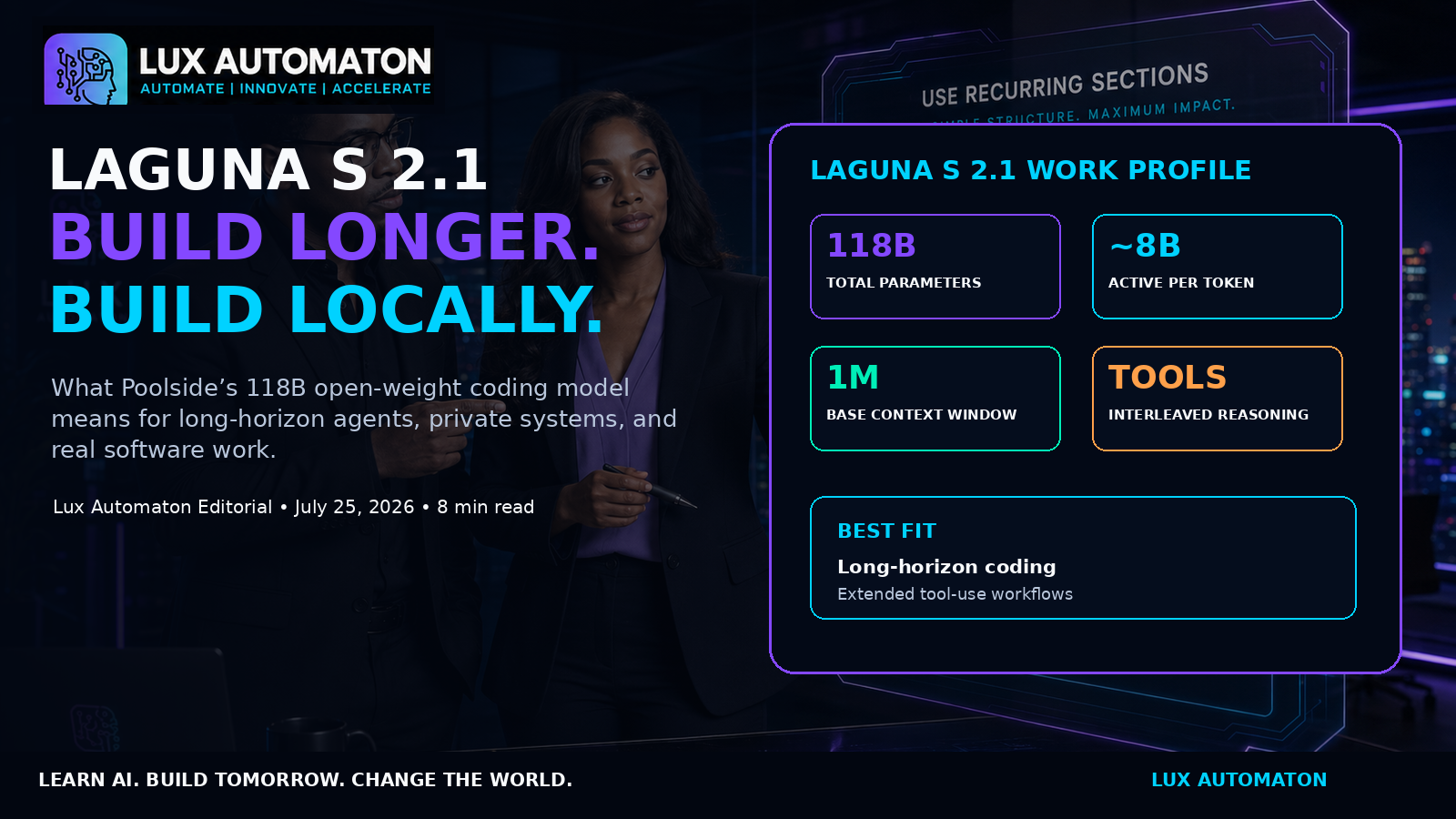
Keep learning with the companion guide.
Open this simple resource in a new tab, then use it at your own pace.
Open the free guide →The source video makes an exciting promise: build anything with Laguna S 2.1. That headline captures the direction of modern coding agents, but the practical version deserves more precision.
Laguna S 2.1 is an open-weight text-to-text model from Poolside designed for agentic coding, long-horizon software work, and extended tool-use workflows.
**Can this model complete one difficult job in my environment with acceptable quality, review time, hardware cost, and risk?**
01 — Long-horizon coding is more than generating a large answer
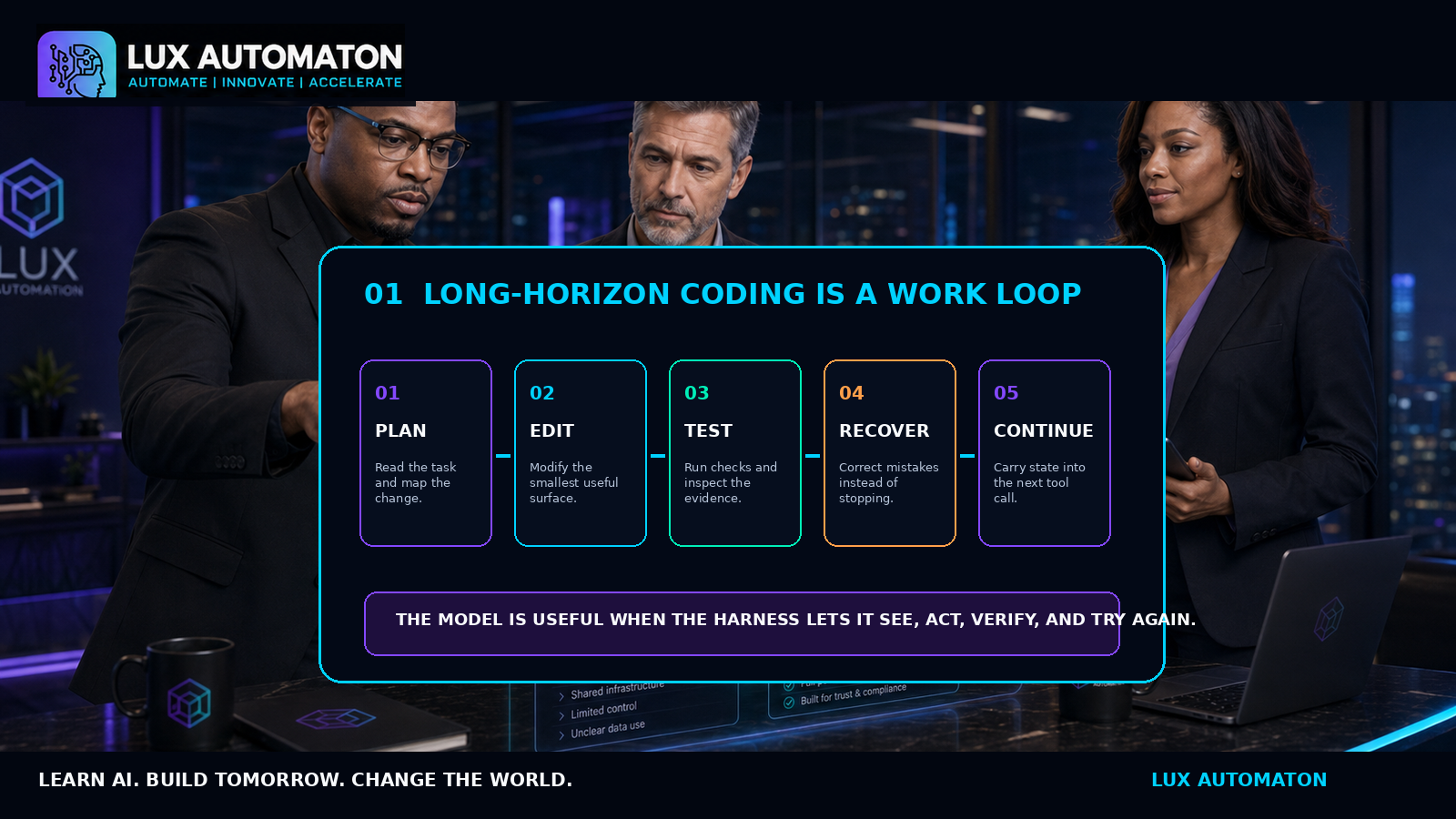
A long-horizon coding agent treats requests as a sequence of connected states: Inspect repo -> Find architecture -> Identify safe boundary -> Plan -> Edit -> Run tests -> Inspect result -> Recover -> Return evidence.
Reasoning between tool calls matters
Poolside's model card supports interleaved reasoning before and between tool calls. It does not blindly execute a fixed plan; it uses action results to decide the next step.
One million tokens is context—not guaranteed understanding
The base model lists a 1,048,576-token context window. A large context window allows holding deep code and docs, but tools must still direct model attention to the right files.
02 — '118B total, 8B active' changes the hardware conversation
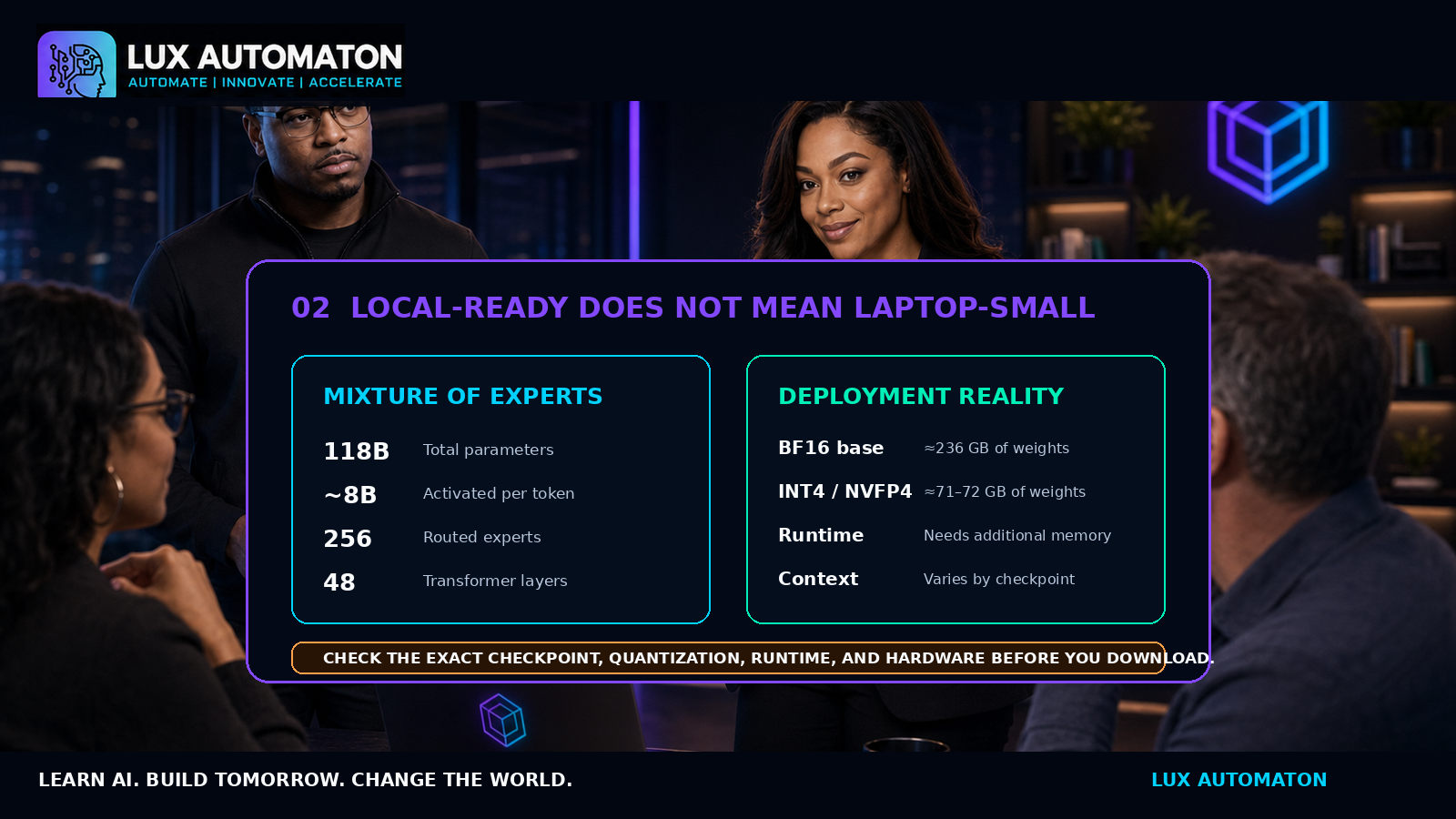
Laguna S 2.1 uses a Mixture-of-Experts (MoE) architecture. The full model contains ~118B parameters, while ~8B are active per token.
Base BF16 weights require ~236 GB VRAM. Quantized INT4 and NVFP4 variants require ~71–72 GB before runtime overhead and KV cache.
03 — A production pilot matters more than a benchmark victory lap
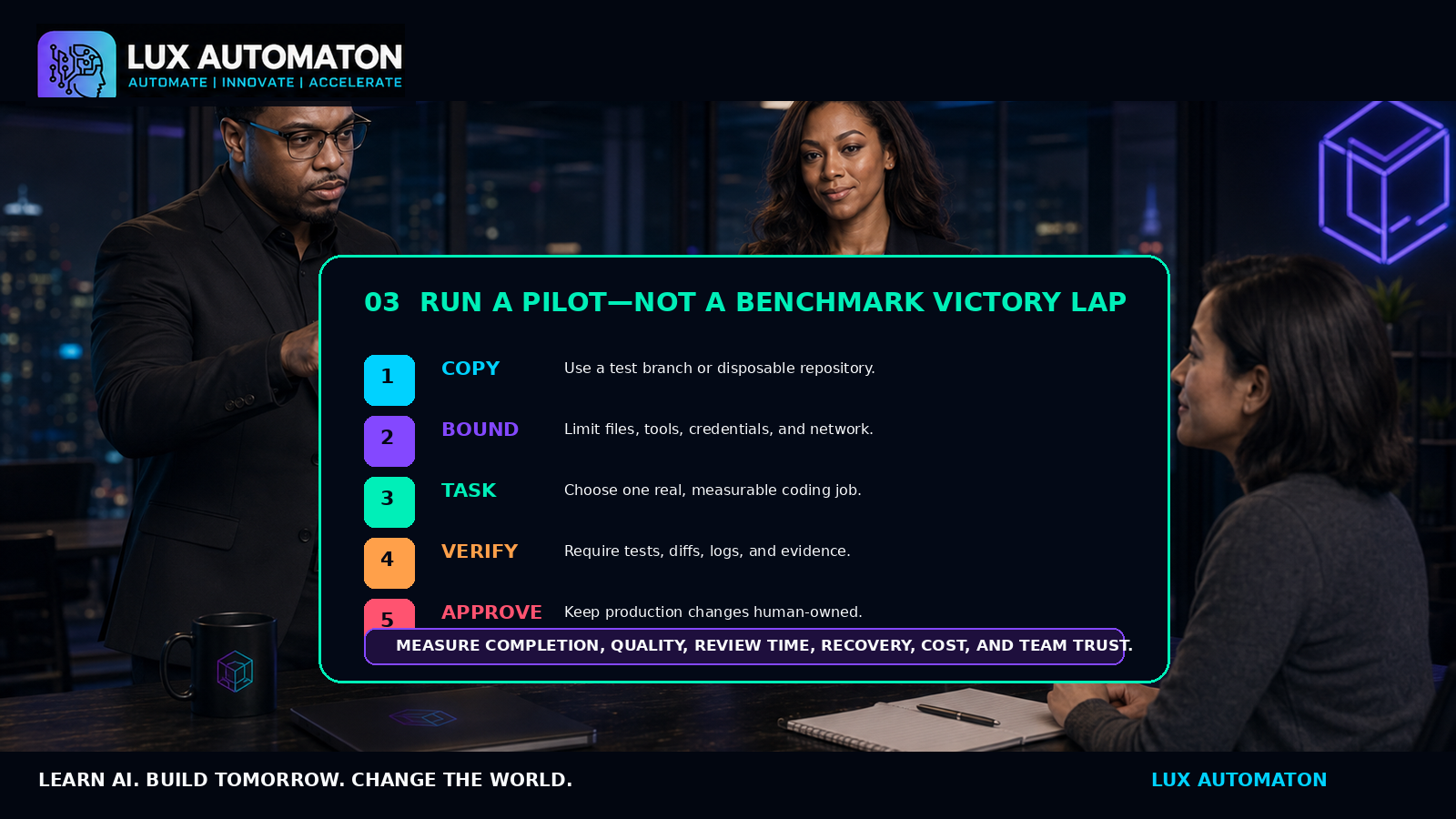
Poolside reports 70.2% on Terminal-Bench 2.1 and 78.5% on SWE-bench Multilingual as of July 21, 2026. Benchmarks justify a pilot, not immediate production access.
Step-by-step pilot framework
1. Choose a bounded task: Upgrade a library, add one endpoint, or fix a reproducible bug. 2. Disposable workspace: Copy repo, test branch, separate credentials. 3. Acceptance criteria: Passing tests, max review time, rollback method. 4. Require evidence: Plan, diffs, commands executed, test results. 5. Keep production human-owned: A named human approves pull requests and deployments.
Laguna S 2.1 System Overview
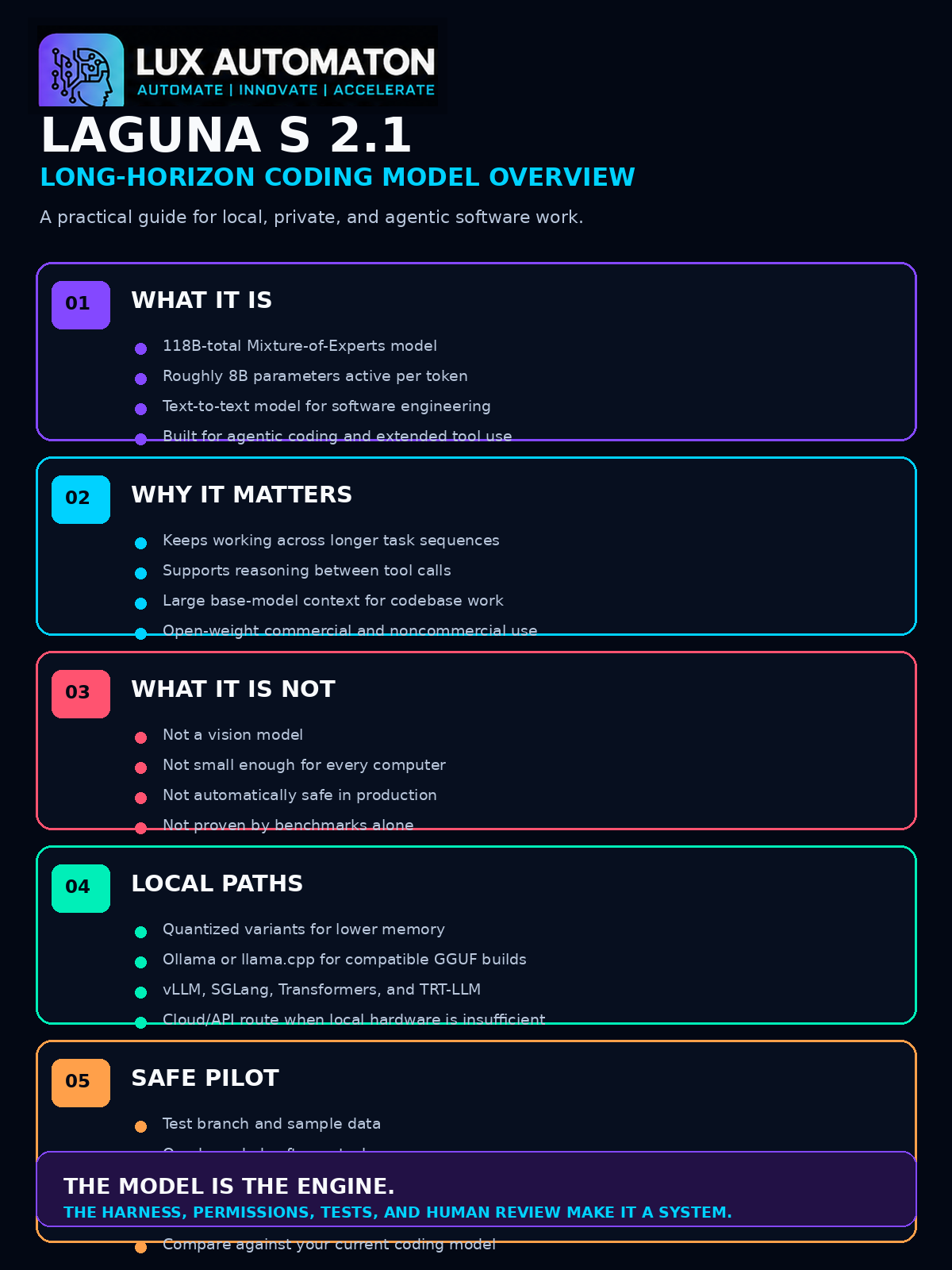
Laguna S 2.1 brings serious long-horizon coding into open-weight models. Run a controlled pilot before adopting it as your default engine.
**“AI should work for you.” — Asa Pritchard** **Learn AI. Build Tomorrow. Change the World. — LANA**
Your next action
Open the Laguna S 2.1 Model Pilot Planner (/documents/laguna-s2-1-model-pilot-planner.html) and download the Model Pilot Template JSON (/documents/laguna-s2-1-model-pilot-template.json). Run one test repository task and compare Laguna S 2.1 with your current coding model.