Keep learning with the companion guide.
Open this simple resource in a new tab, then use it at your own pace.
Open the free guide →A recent video titled “NEW Google Gemini Updates Are INSANE!” runs through a wave of launches across image creation, video, music, creative workspaces, AI agents, education, and mobile devices. The useful lesson is not that Google released many features at once. The lesson is that tools that once lived in separate tabs are beginning to behave like one connected AI stack.
That direction matters for a small business. A founder can move from a campaign idea to a visual concept, a short video, an audio bed, a draft follow-up, and a mobile next action with fewer handoffs than before. But fewer handoffs do not automatically create a better business. The owner still needs a clear goal, approved context, quality standards, privacy rules, and a person who makes the final decision.
This Lux Automaton breakdown turns the update wave into a practical question: What should a small business test first—and what should it ignore until there is a real job to do?
**Watch the source video:** [NEW Google Gemini Updates Are INSANE!](https://www.youtube.com/watch?v=ZBFbyTS_C0k)
01 — Connect the creative stack
Google’s February 2026 Gemini Drop brought several creative capabilities into the same orbit. Nano Banana 2, also called Gemini 3.1 Flash Image, emphasized faster visual generation, stronger real-world knowledge, more legible text, and the ability to translate or localize text inside an image. The same update introduced Veo Templates for video and Lyria 3 for music creation.
The larger shift continued through Google Flow and Gemini Omni. Flow is moving toward a connected creative workspace where people can generate, edit, organize, and iterate across media. The business advantage is not “unlimited content.” It is the ability to build an asset family from one approved brief.
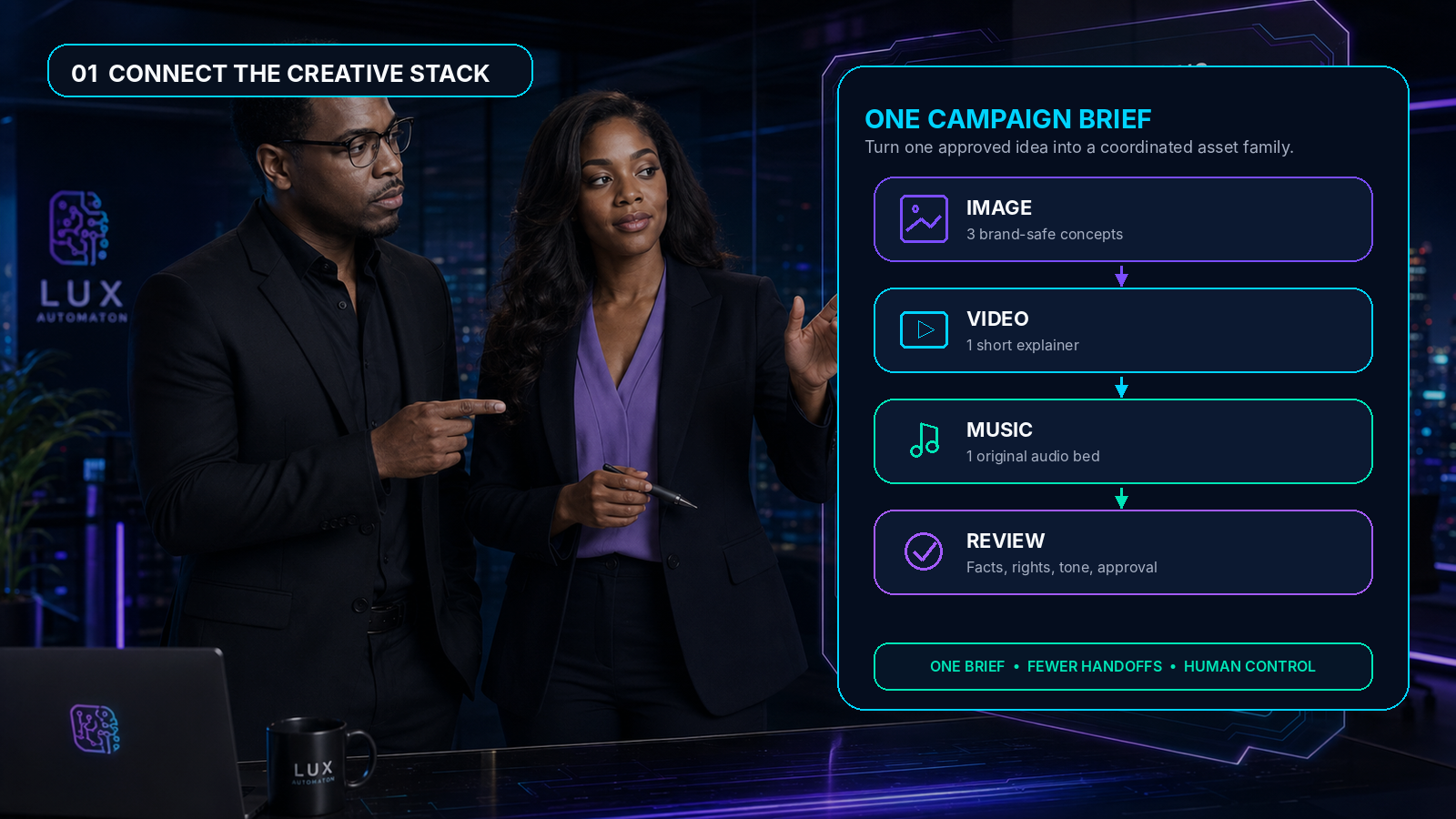
A useful first workflow might look like this:
1. Start with one campaign brief. Define the offer, audience, proof, tone, required facts, and prohibited claims.
2. Create image concepts. Generate a small number of visual directions instead of dozens of random options.
3. Turn the chosen direction into a short video. Use the same product details, customer promise, and visual references.
4. Add an original audio bed when it helps. Music should support the message, not distract from it.
5. Review before publishing. Check facts, spelling, visual consistency, rights, consent, accessibility, and brand fit.
“The advantage is not more content. It is fewer handoffs between a good idea and an approved result.” — LANA
02 — Give agents a narrow, reviewable job
The video also points to Google Opal, a no-code tool for building AI mini-apps and workflows. In February 2026, Google upgraded Opal with agentic steps that can choose tools and models based on a goal instead of following only a fixed sequence. That makes the workflow more flexible—but it also makes clear boundaries more important.
A small business should not begin with “run my company.” Begin with one lane where the inputs, outputs, and approval point are easy to see.
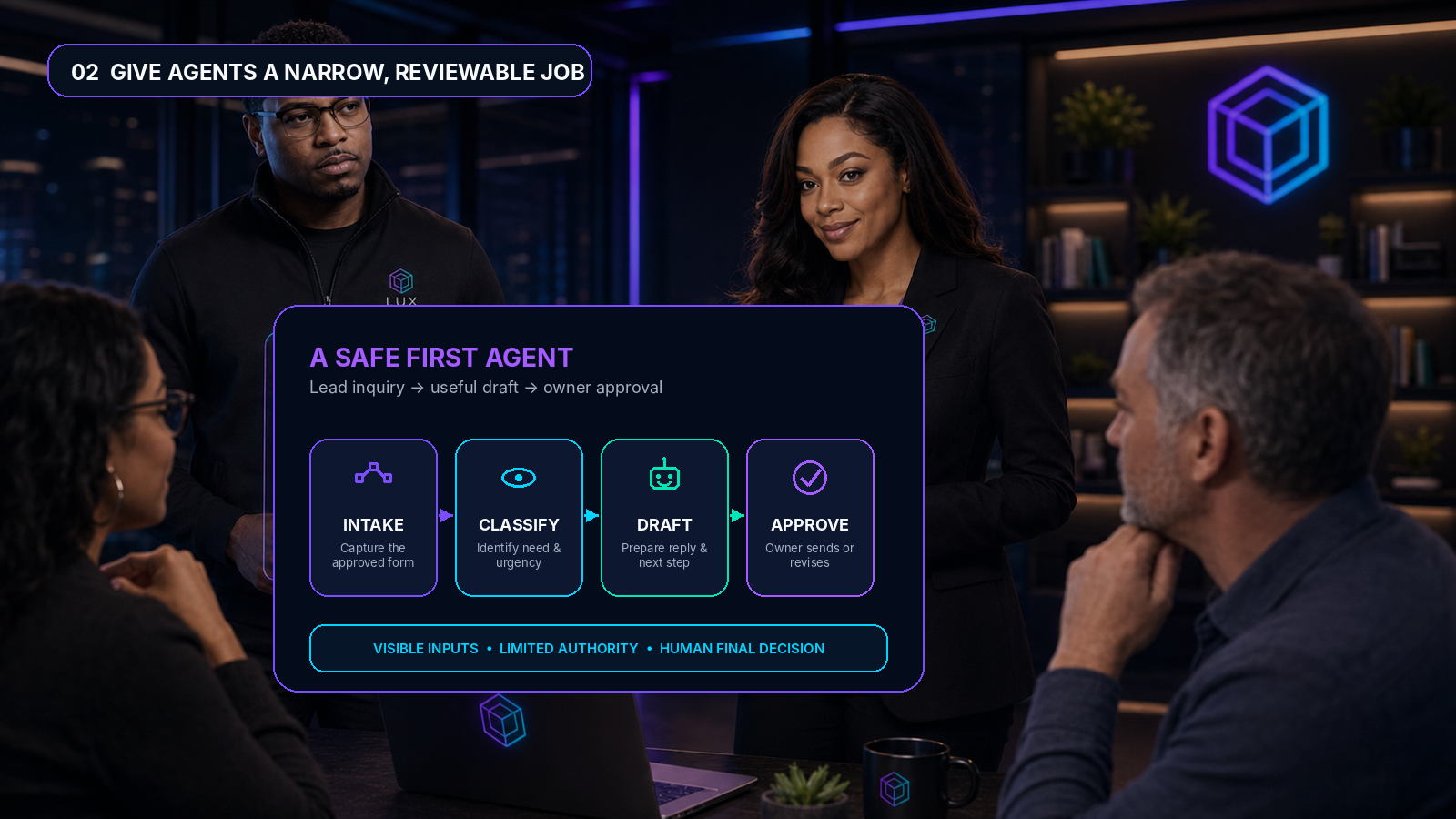
A practical first agent could help with new inquiries:
- Intake: A customer submits an approved contact form.
- Classify: Identify the request, category, and urgency level.
- Draft: Prepare a helpful reply and recommended next step.
- Approve: The owner or team member edits and approves the message before sending.
“Give the agent a lane, a finish line, and a person who owns the decision.” — Asa Pritchard
03 — Build an adoption rhythm, not a tool collection
Two less obvious updates in the video reveal the long-term strategy. Google announced free AI literacy training intended for all six million K–12 and higher-education teachers in the United States. Google also introduced more on-device and multi-step Gemini experiences for newer Android phones, including the Samsung Galaxy S26 series.
Those announcements point in the same direction: AI is becoming part of everyday skills and everyday devices. For a business owner, that means the advantage will come less from knowing the newest feature name and more from helping a team use a few capabilities responsibly and repeatedly.
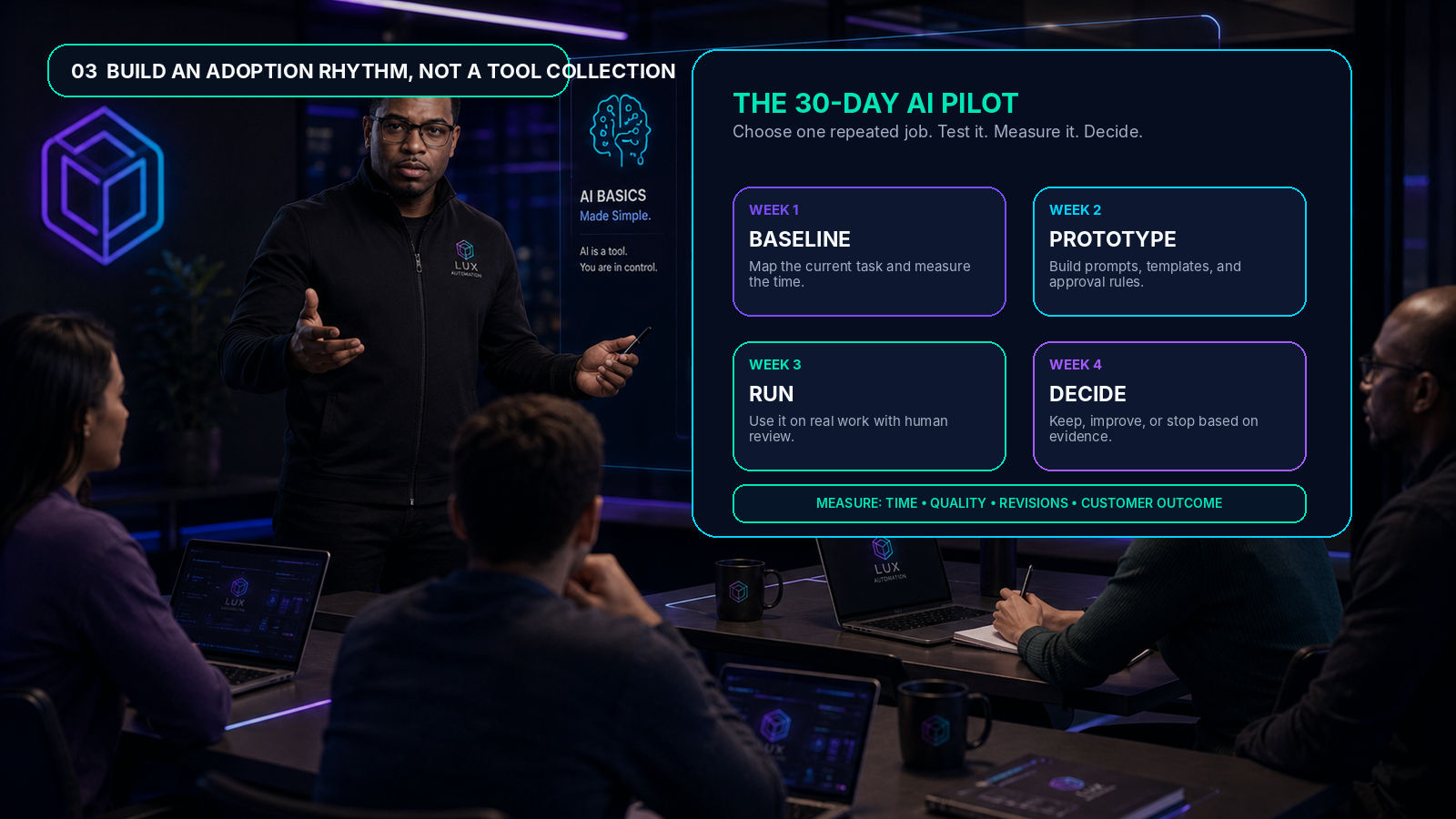
Run a thirty-day pilot instead of rebuilding the business around a launch video:
The 30-Day AI Pilot
- Week 1 (Baseline): Map the current task and measure the time.
- Week 2 (Prototype): Build prompts, templates, and approval rules.
- Week 3 (Run): Use it on real work with human review.
- Week 4 (Decide): Keep, improve, or stop based on evidence.
Four useful systems to consider first
- A campaign asset kit: One approved brief becomes a coordinated graphic, short video, audio option, email, and landing-page outline.
- A lead-response assistant: A narrow agent classifies inquiries, drafts replies, identifies missing details, and prepares the next step for approval.
- A knowledge-to-training kit: Internal procedures become short explainers, examples, quizzes, and workshop material for the team.
- A mobile daily brief: Important appointments, open tasks, customer context, and next actions are summarized for the owner or field team.
Quick-read overview and planner
Open the Gemini Update-to-Workflow Action Planner ⚡
---
Product notes and sources
This independent editorial article was inspired by the linked video and checked against official Google product announcements available on July 23, 2026. Feature names, access, pricing, regions, limits, and preview status may change.
- Source video: NEW Google Gemini Updates Are INSANE!
- Google: Gemini Drop — February 2026
- Google: Build dynamic agentic workflows in Opal
- Google: New agents and Gemini Omni for Google Flow
- Google: AI literacy training for six million U.S. teachers