
Keep learning with the companion guide.
Open this simple resource in a new tab, then use it at your own pace.
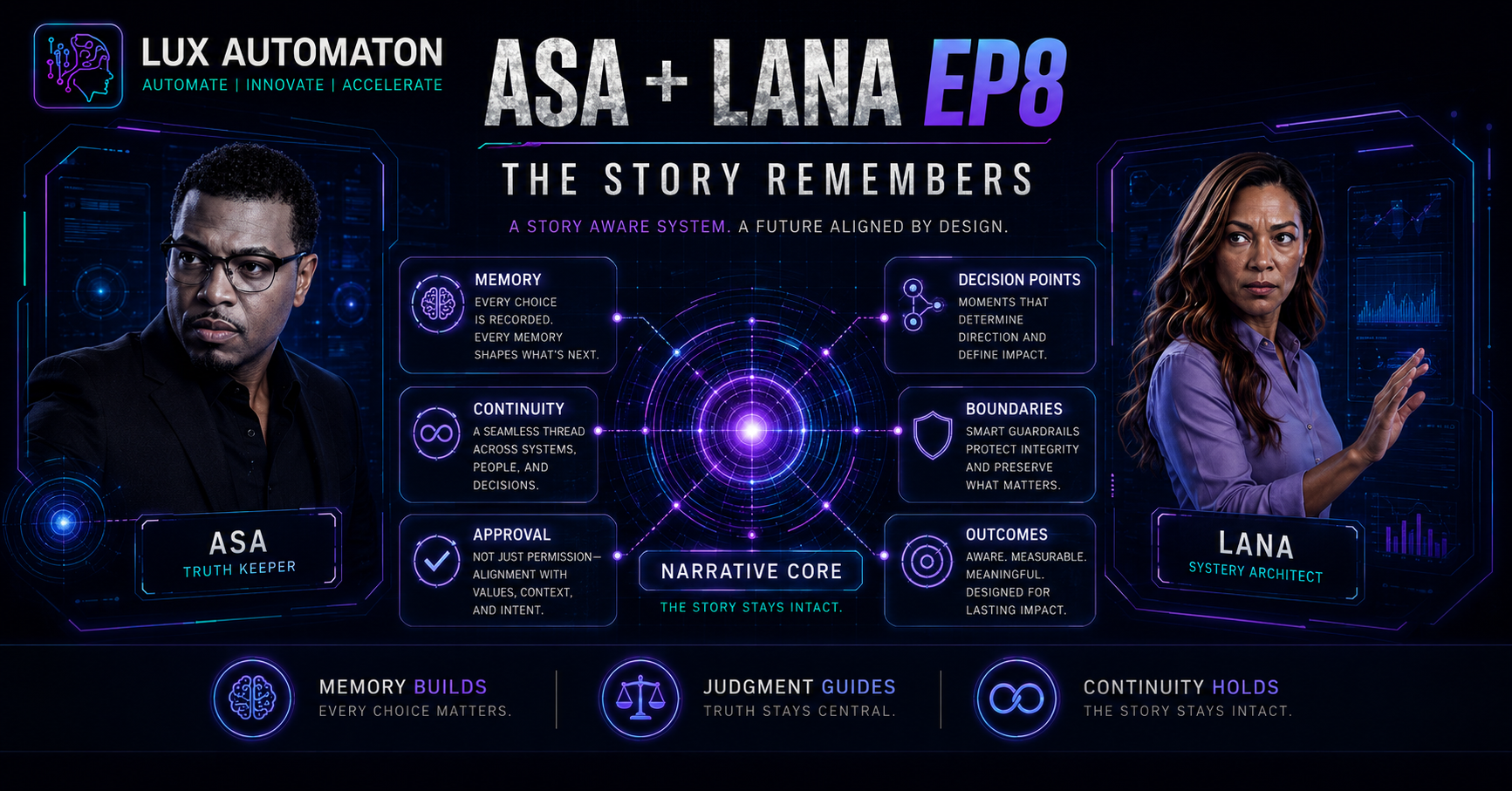
Open the free guide →Episode 8 brings the central promise of Asa + LANA: The Story Remembers into focus.
The Lux Codex can now preserve characters, locations, scenes, timelines, perception records, world state, and approved changes. But memory alone is not the final goal. A story system must also understand relationships between moments—recognizing that one decision changes what becomes possible next.
Episode 8 introduces the Narrative Core—the layer where memory, judgment, continuity, boundaries, and outcomes meet.
**The story remembers because every accepted choice becomes part of what the future must respect.**

01 — A living story needs more than saved scenes
A folder of scenes is an archive. A narrative memory is a connected model of what happened, why it mattered, and what changed because of it.
Earlier episodes established Story Memory, Character Identity Locks, Reality Memory, Story Bible Core, Story Perception, Global Story Map, and the Canon Decision Ledger. Episode 8 connects those systems through the Narrative Core.

Origin events and decision points
An origin event creates a new branch in the story. A decision point is the moment when the story could move in more than one direction. The system preserves options considered, risks, recommended paths, rejected paths, human decisions, reasons, and actual outcomes.
02 — Boundaries protect the difference between memory and control
Episode 8 introduces one of the most important ideas in the series: a system needs limits around what it is allowed to remember, change, and influence.

Story, Memory, and Action Boundaries
The story boundary defines what belongs inside the project. The memory boundary defines what can become durable (allowing approved scene outcomes while forbidding credentials or private client data). The action boundary ensures LANA flags risks and isolates fragments without independently publishing or overriding human decisions.
03 — Human approval keeps the future aligned with intent
Episode 8 ends where the Lux system must always return: human judgment. The Narrative Core can show memory, risks, outcomes, and recommended paths, but it cannot replace creator responsibility.

Approval is more than permission
A strong approval evaluates Intent, Ethics, Impact, Continuity, Authority, and Reversibility. The system compares expected and actual outcomes so the story learns from every choice.
**“The story remembers the choice. The creator remains responsible for what comes next.” — Asa Pritchard** **Learn AI. Build Tomorrow. Change the World. — LANA**
Downloads & Subscriber Tools
Download the Narrative Core Decision Workbook (/documents/narrative-core-decision-workbook.html), Lux Codex JSON Template (/documents/lux-codex-narrative-core-template.json), HTML Edition (/documents/asa-lana-ep8-the-story-remembers.html), and Markdown Source (/documents/asa-lana-ep8-the-story-remembers.md).