
Keep learning with the companion guide.
Open this simple resource in a new tab, then use it at your own pace.
Open the free guide →The first three episodes of Asa + LANA: The Story Remembers solved three different continuity problems.
Episode 1 introduced the central idea: a story needs a memory.
Episode 2 connected scenes, locations, props, rules, and timelines through the Story Memory Tree.
Episode 3 protected the people at the center of the series through Reality Memory and the Character Identity Lock.
Episode 4 brings those systems together into the Story Bible Core—the central memory architecture behind the entire world.
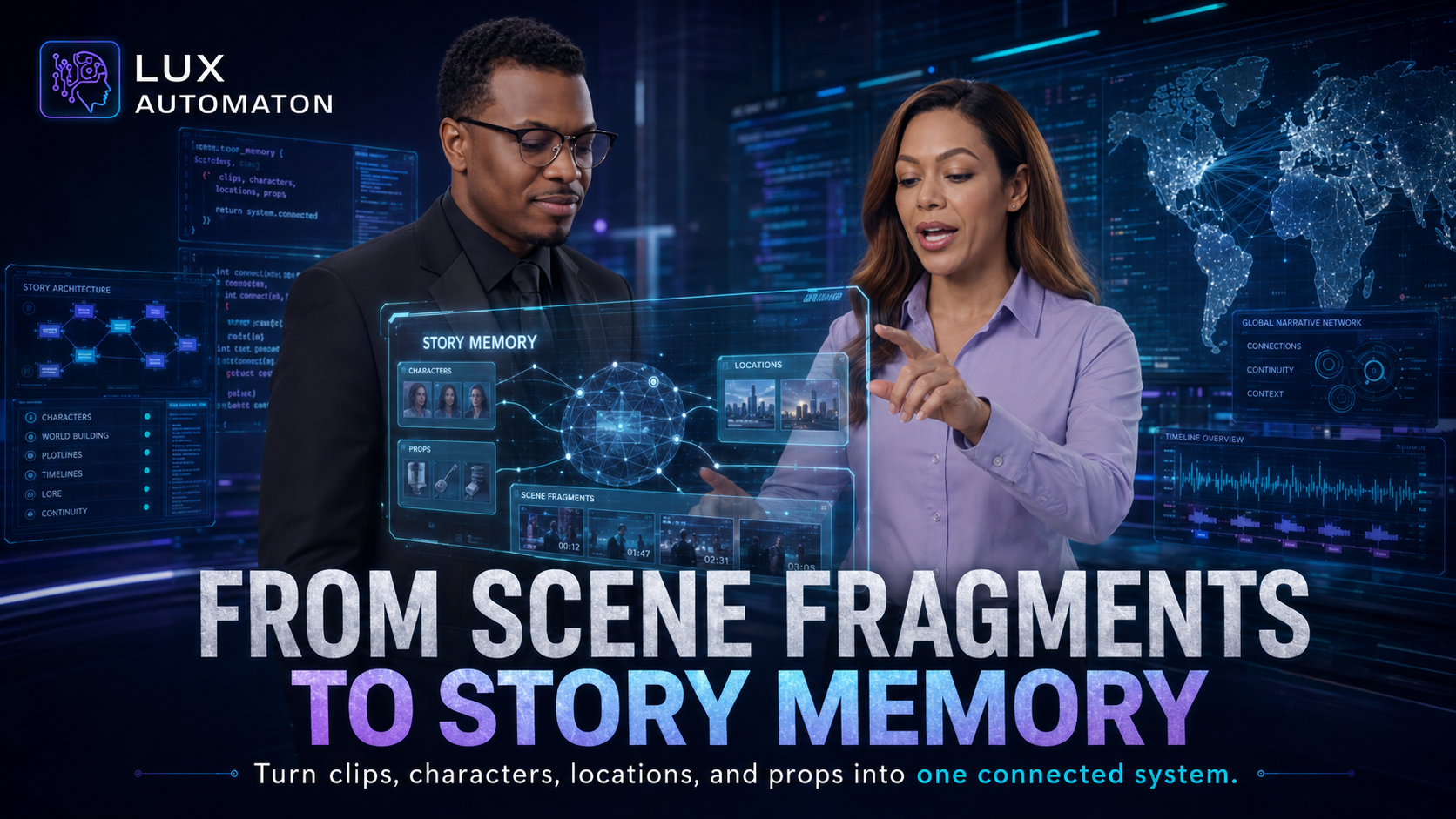
This is where a collection of clips becomes a real series.
**A series is not only a sequence of scenes. It is a connected system of people, places, history, rules, relationships, and change.**
01 — A series needs more than clips and prompts
AI video tools are excellent at producing moments: a futuristic laboratory, a dramatic conversation, a glowing city, or a character discovering a secret. Each clip may look impressive, but a series asks harder questions.
What happened before this scene? What does the main character know now? Which location are they in? What rules govern the world?
When character notes, location images, prompt lists, and timeline notes stay separated in different folders, the creator has to remember every connection by hand. That leads to character drift, world drift, timeline drift, lore drift, and theme drift.

**Asa’s note:** 'A prompt can create the next moment. The Story Bible Core preserves the meaning and history behind that moment.'
02 — The Story Bible Core turns fragments into connected memory
The Story Bible Core organizes the system into connected pillars:
1. Characters & Identity Locks: Profiles, approved reference packs, facial anchors, wardrobe history, voice, and current states. 2. Worldbuilding: Regions, locations, factions, technology rules, and environmental physics. 3. Lore Architecture: Audience-known facts versus creator-only secrets. 4. Continuity Engine: Timelines, events, consistency checks, and canon integrity. 5. Scene Memory: Approved beats, starting/ending states, and context recall. 6. Approval Controls: Human decision ledger ensuring rejected generations never update official memory.

03 — A global story map keeps identity, world, and timeline aligned
Episode 4 expands the continuity engine into a Global Story Map connecting characters, regions, locations, relationships, timeline events, lore, audience touchpoints, and production status.
This transforms the Story Bible from a passive reference document into an active production operating system.
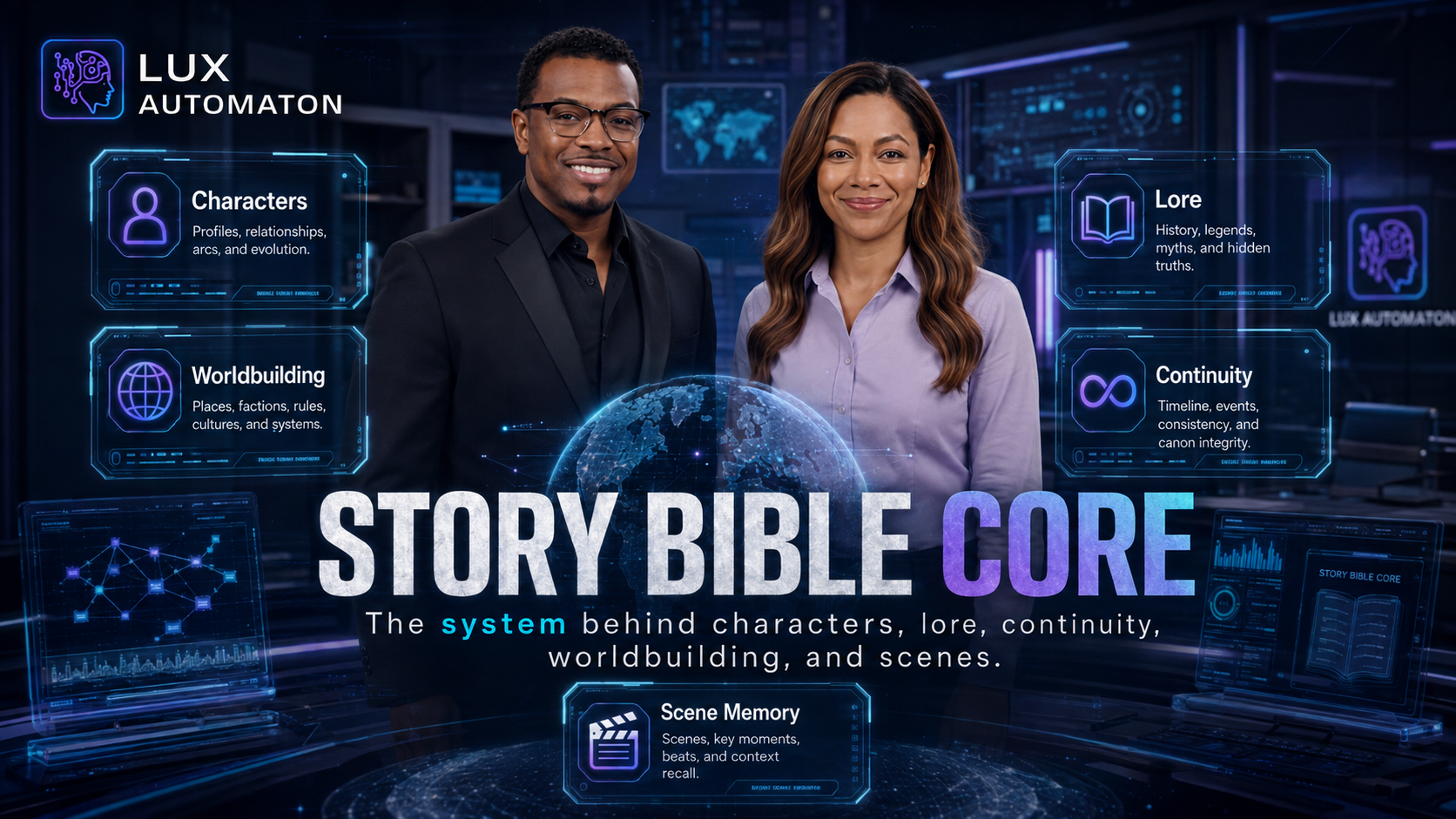
Story Project Memory Architecture
`text
Story Project
├── Story Promise
├── Themes
├── Characters
│ ├── Identity Locks
│ ├── Relationships
│ ├── Current States
│ └── Change Logs
├── Worldbuilding
├── Lore
├── Props
├── Timeline
├── Scenes
├── Continuity Checks
├── Global Story Map
├── Approval Ledger
└── Publishing Memory
`
That gives Asa and LANA a system that remembers not only what happened, but who it happened to, where it happened, what the world allows, what the audience knows, and what must happen next.
**“Give the series a system that remembers.” — Asa Pritchard** **Learn AI. Build Tomorrow. Change the World. — LANA**
Your next action
Open the Story Bible Core Builder (/documents/story-bible-core-builder.html) and download the Lux Codex Story Bible Core Template (/documents/lux-codex-story-bible-core-template.json). Fill out your story promise, character identity locks, worldbuilding rules, and global story map before rendering your next scene.