
Keep learning with the companion guide.
Open this simple resource in a new tab, then use it at your own pace.
Open the free guide →Episode 1 of Asa + LANA: The Story Remembers introduced the problem.
A scene could look beautiful and still forget the story that came before it. A character’s face changed. A location lost its details. A prop disappeared. The next prompt produced a new clip—but not necessarily the next part of the same world.
Episode 2 asks the question that changes the entire series:
**What if the story had a memory?**
The episode opens with Asa surrounded by floating prompt fragments. They contain pieces of the project—scene instructions, character notes, visual choices, and half-remembered decisions. Every piece is useful. None of them knows how it connects to the others.

That is where LANA steps in. Instead of writing one more giant prompt, she begins building the Lux Codex Story Memory Tree: a connected system for the Story Bible, characters, locations, props, rules, scenes, and timeline.
The result is bigger than a prompt library. It is the beginning of a story that can remember itself.
01 — The story did not need another prompt. It needed memory.
AI filmmaking often begins with prompts: Describe the character. Describe the room. Describe the camera. Describe the lighting. Describe what should happen next. That works well for one image or one isolated clip. A series creates a different problem.
By episode two, the creator must remember: What the character looked like; What the character already learned; Which room the character entered; What the room contained; Which objects were carried forward; What time the previous scene occurred; What promise the story made to the audience; Which questions are still open; What must not change.
A long prompt can repeat some of that information. But repetition is not the same as memory. A prompt describes the current request. A memory system preserves the relationship between requests.
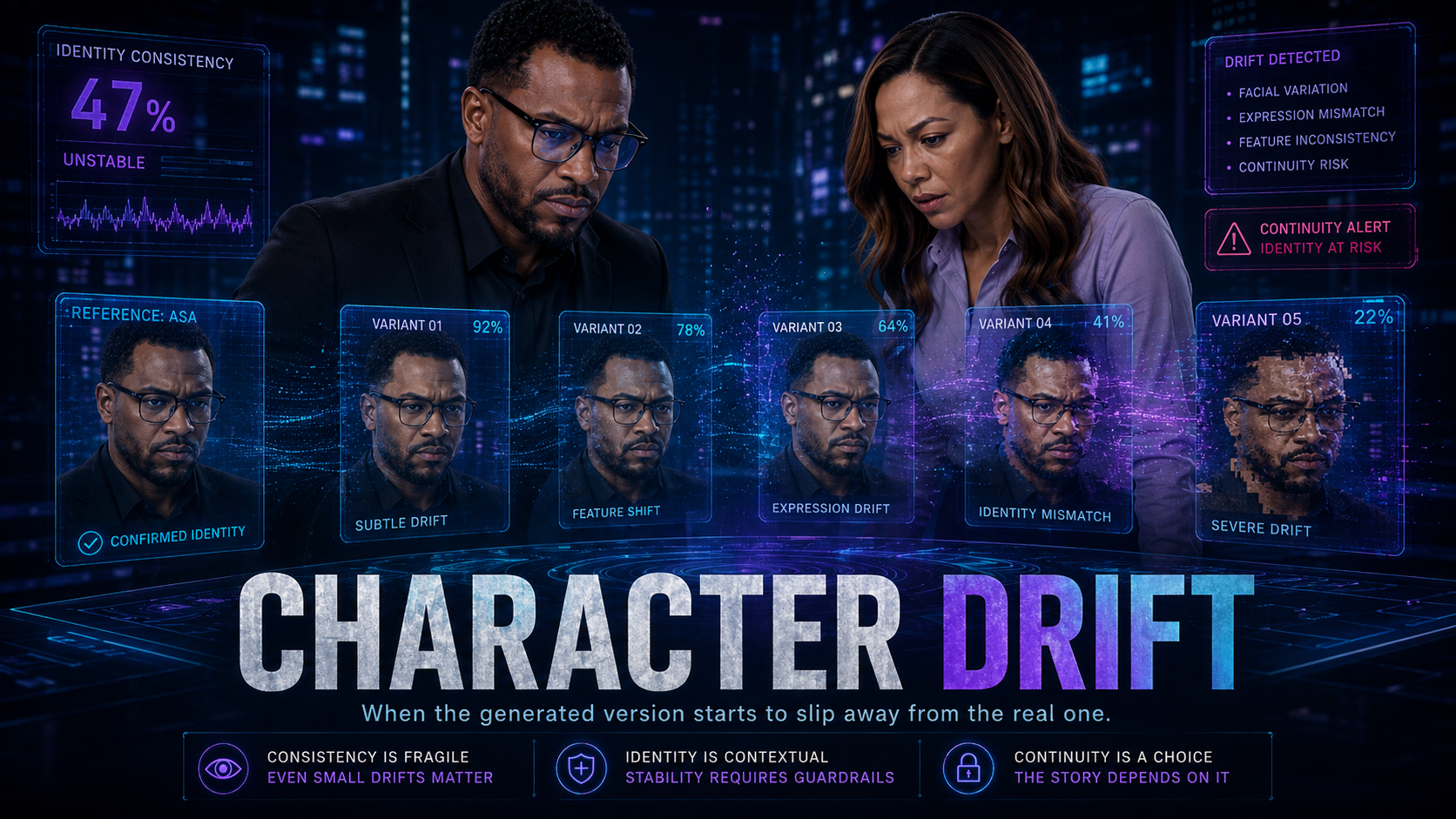
Asa is surrounded by pieces
In the episode, Asa stands inside a field of floating prompt cards. The visual captures a common creator experience. The information exists—but it is scattered.
One card may contain a wardrobe instruction. Another contains a character description. Another contains the location. Another contains the emotional tone. When those pieces remain separate, the creator becomes the only continuity engine.
The human must remember every detail and manually reconstruct the world each time. That creates three problems:
1. Important details become optional: Small details compete for attention and get dropped by the model. 2. Corrections do not carry forward: Fixes in one scene aren't preserved unless recorded in project memory. 3. The story state becomes invisible: Folders contain clips but don't show what characters know or what scene comes next.
**Asa’s note:** “A prompt can create a moment. Memory is what turns moments into a world.”
02 — LANA turns scattered details into a Story Memory Tree
LANA does not solve the problem by creating one enormous document. She creates a connected structure.
The Story Bible Protects the core premise, intended audience, emotional tone, world rules, visual language, and central conflict.
Characters Preserves name, role, appearance, wardrobe, voice, mannerisms, motivation, relationships, knowledge, emotional state, and physical state changes.
Locations Protects room layout, architecture, color palette, lighting, furniture, technology, time of day, weather, entry points, and key objects.
Props Tracks what the object is, who currently has it, where it came from, what it can do, what condition it is in, and when it last appeared.
Rules Defines what the world allows (e.g., LANA analyzes continuity without removing human creative control, Lux visual identity remains dark cinematic cyan/purple).
Scenes Captures scene number, purpose, starting state, action, ending state, characters present, location, props, visual references, and open risks.
Timeline Answers: What happened? In what order? What changed because it happened?
03 — Continuity gets scored before the next render
Episode 2 introduces one of the most important Lux Codex ideas: the Continuity Score. LANA displays a score of 98.
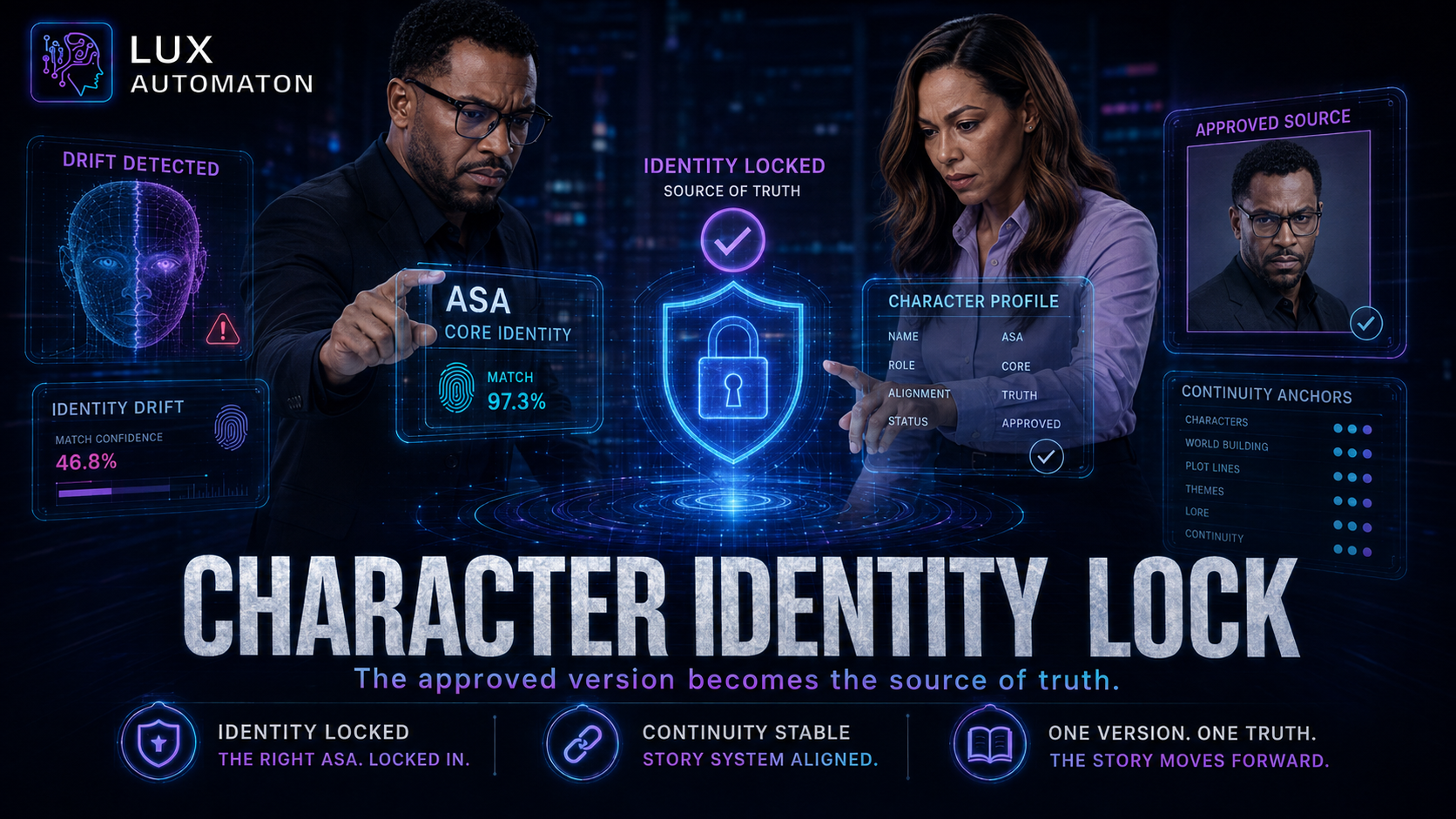
Before the next scene is rendered, the system reviews whether the proposed scene agrees with current memory across five areas:
1. Character identity: Face match, wardrobe timeline, voice, emotional connection. 2. Location continuity: Correct place, matching environment, time of day, key room details. 3. Prop continuity: Required objects visible, correct owner, unexplained changes. 4. Timeline logic: Event order, character knowledge state, elapsed time, zero contradictions. 5. Story purpose: Advances the episode, supports the promise, creates a useful next move.
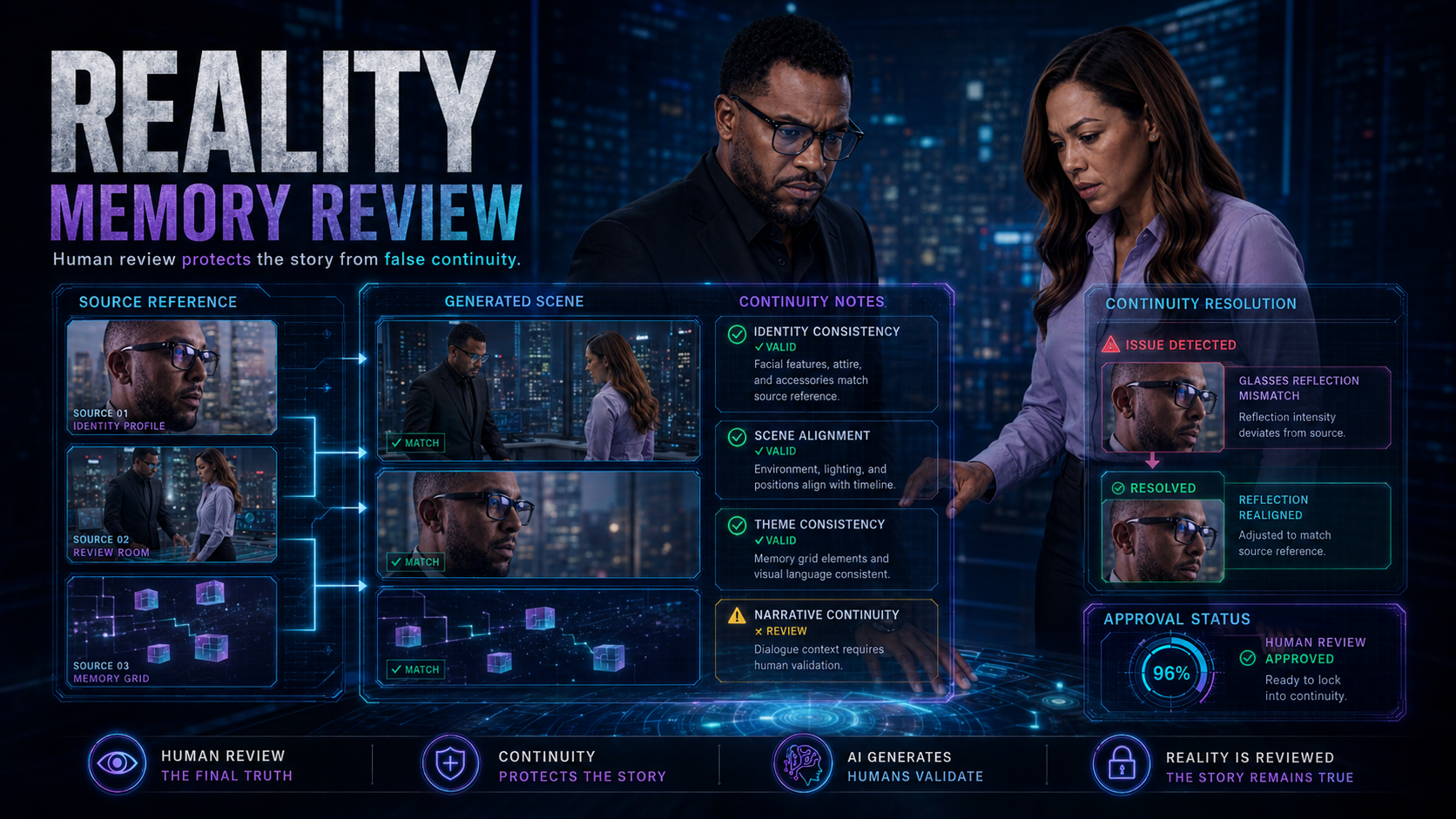
The production rhythm introduced in Episode 2
1. Read current story state: Load Story Bible, characters, location, props, rules, timeline. 2. Define next scene purpose: Write one sentence explaining what the scene must accomplish. 3. Build scene brief: Include only required memory, visual references, and desired ending state. 4. Run continuity check: Compare proposed scene against current story memory. 5. Review risks: Director approves intentional changes and corrects accidental ones. 6. Render the scene: Generate scene only after brief is stable. 7. Update memory: Record what actually happened—not only what prompt requested.
The takeaway
Episode 2 begins with fragments and ends with a living tree. The story moves from prompts to memory, files to relationships, scenes to state, guessing to checking, and random generation to intentional directing.
**“One clip is just a seed. A series needs a soul.” — Asa Pritchard** **Learn AI. Build Tomorrow. Change the World. — LANA**
Your next action
Open the Story Memory Blueprint included with this episode. Choose one project and complete four sections today: core story promise, two character records, current location, and timeline through the latest scene. Then write the next scene from memory.